A significant milestone has been achieved in the development of 2 Finsbury Avenue, a prominent addition to the City of London skyline, as the structure has topped out at level 37 on British Land’s Broadgate campus. This ambitious mixed-use commercial development, spanning 750,000 sq ft, is now a visible part of the capital’s architectural landscape. Engineers involved in the project highlight that the successful progression of the scheme was heavily reliant on intricate ground engineering works conducted during the initial construction phases.
2 Finsbury Avenue is at the forefront of the area’s transformation, designed with a commitment to sustainable engineering excellence and innovative architecture. A topping-out ceremony was recently held to celebrate the completion of the superstructure of the dual-tower structure, which commenced in 2023, with an anticipated completion date set for 2027.
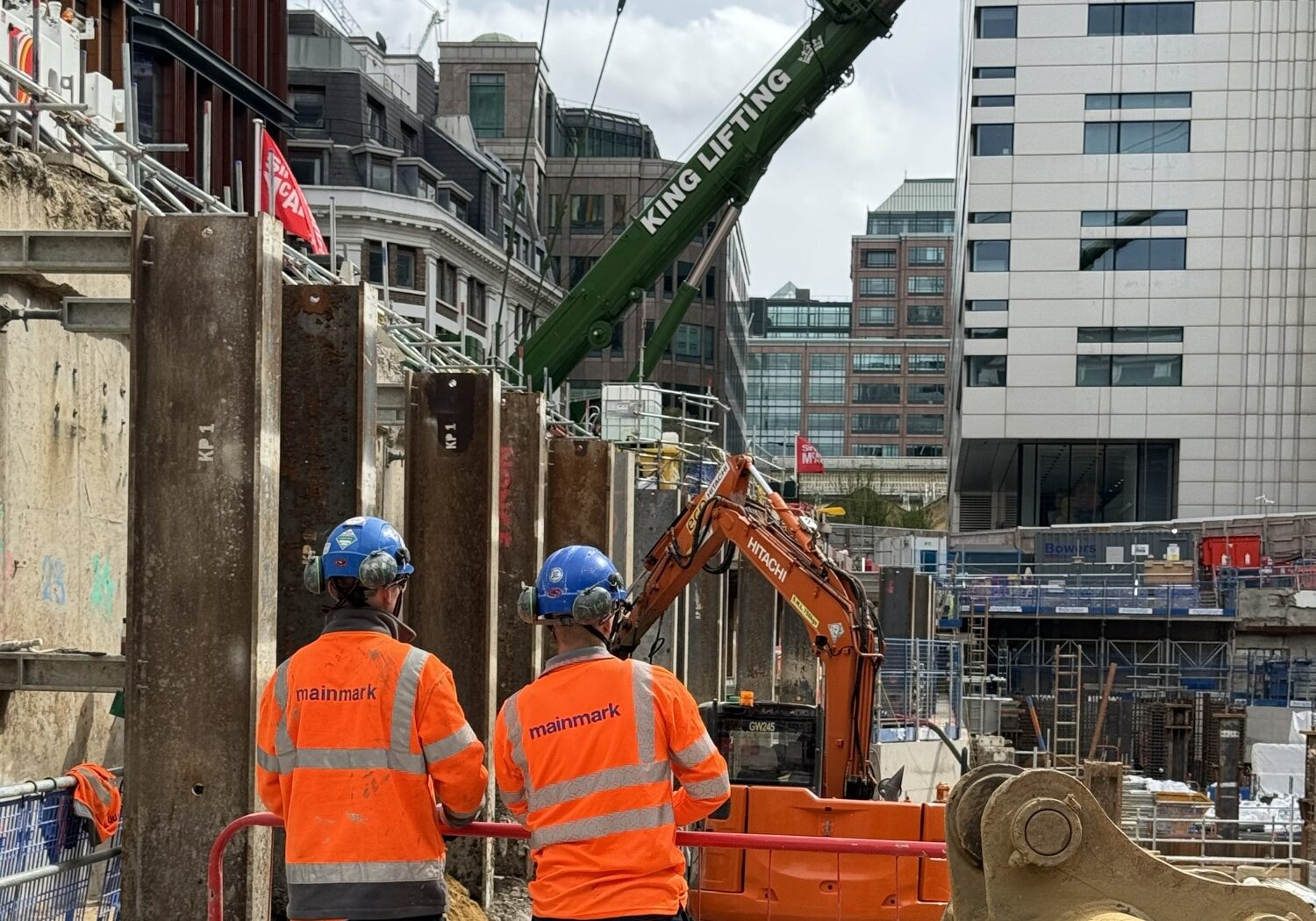
During the early stages of construction, specialist contractor Mainmark was engaged to stabilise ground conditions and facilitate the excavation necessary for the development’s basement structure. The project faced complex ground conditions, which the expert ground engineering team addressed as a vital component of the early construction programme.
A secant piled wall had been partially constructed for the basement of the new office building, but the site was constrained by an existing reinforced concrete cantilever retaining wall, which was supported by discrete concrete piles installed at 7.5m intervals. To install a reinforced concrete capping beam above the secant piles, excavation was required directly in front of the retaining wall, exposing the soil beneath the existing structure and potentially jeopardising stability.
Mainmark was tasked with devising a ground stabilisation solution that would allow excavation to proceed safely while safeguarding surrounding infrastructure in this densely populated urban setting. Initially, the team employed its Teretek® resin injection technology, which involves injecting expanding resin into the soil to fill voids and compact loose ground, thereby enhancing its load-bearing capacity. This minimally invasive technique effectively stabilised the soil during the early phases of work, mitigating the risk of ground movement during excavation.
However, given the extensive area requiring stabilisation, the engineering team later transitioned to permeation grouting, a method that bonds soil particles together to form a solidified mass capable of supporting additional loads and serving as a temporary shoring solution. Mainmark also collaborated with the project team to develop a temporary works design, adapting their approach throughout various phases of the project to ensure programme efficiency.
The successful ground stabilisation efforts enabled excavation to continue safely, allowing for the construction of the reinforced concrete capping beam, which facilitated uninterrupted progress on the substructure works. Given the site’s central location in the City of London, surrounded by businesses and pedestrian traffic, a low-impact engineering approach was paramount. Mainmark’s ground improvement methods minimised disruption to neighbouring properties and reduced the risk of ground movement affecting adjacent structures, thereby supporting the broader construction programme for the basement and core structure.
Lee Henry, Project Manager at Morrisroe, who oversaw demolition and basement construction on the project, commended the collaborative approach adopted during the works. He remarked, “Work on demolition, substructure and superstructure construction processes can be unpredictable, and it’s therefore crucial that ground engineers are on hand should you need them. The Mainmark team were a pleasure to work alongside, carrying out the necessary work to stabilise and strengthen the ground efficiently with little disruption to our team or the project as a whole. It was clear throughout the project that we were working towards the same goal, and their input allowed us to continue our work with peace of mind.”
Upon completion, 2 Finsbury Avenue is set to provide approximately 750,000 sq ft of mixed-use commercial space, featuring a 36-storey East Tower, a 21-storey West Tower, and a 13-storey connecting podium. The building is being developed as an all-electric facility, targeting BREEAM Outstanding, WELL Platinum, EPC A, and NABERS 5-star ratings, underscoring the project’s sustainability objectives. Morrisroe has completed the reinforced concrete cores, floor slabs, and top-down basement construction, utilising around 40,000 tonnes of concrete. The building’s structural integrity is supported by 280 secant piles and 78 bearing piles extending up to 50 metres deep, reflecting the substantial engineering efforts involved in this landmark project.