
Polished Concrete Floors: Durable, Designer and Surprisingly Affordable
Polished Concrete Floors
Polished concrete floors are fast becoming a favourite in both contemporary UK homes and commercial spaces, prized for their durability, low-maintenance appeal, and sleek, modern look. In this feature, we explore what makes them such a compelling choice. From hard-wearing performance and effortless cleaning to their thermal properties and contribution to indoor air quality, polished concrete offers more than just style.
We take readers through the spectrum of finishes, from subtle matt honed surfaces to high-gloss mirrors, including coloured options and exposed-aggregate designs that bring unique character to each space. Typical UK costs are outlined, giving a clear idea of budget expectations.
Whether in kitchens, living areas, bathrooms, retail outlets, or industrial environments, polished concrete demonstrates remarkable versatility. Its compatibility with underfloor heating makes it especially appealing for modern interiors. Sustainability is also addressed, with insights on embodied carbon, longevity, and eco-friendly benefits. Health and safety considerations, including slip resistance and VOC levels, are explained for peace of mind.
The article guides readers through the installation journey with a handy flowchart and realistic timelines, while highlighting the difference between DIY projects and professional installation. Maintenance tips, potential issues like cracking or staining, and solutions are covered to help homeowners make informed choices.
We round off with profiles of leading UK providers and materials suppliers, illustrated with tables and real-life case studies. A reader-friendly FAQ section answers pressing questions, such as “How slippery is polished concrete?” or “Can it be tinted?” Throughout, practical UK examples and pricing details provide context, while references ensure readers can explore further.
Benefits of Polished Concrete Floors
Polished concrete is prized for its hard-wearing durability and low maintenance. A properly laid and polished concrete slab resists heavy foot traffic, furniture movement and minor impacts better than many floor finishes. It rarely needs replacement over decades – there are no coatings or laminates to peel off – and cleaning simply involves dust-mopping and occasional damp mopping with mild cleaners. Scratches or chips from heavy items are far less visible than on wood or laminate. Modern sealers and densifiers mean polished concrete can be stain-resistant too, though spills of strong acids or oils should be cleaned promptly.
Because concrete has high thermal mass, polished floors help regulate indoor temperatures. They absorb and store heat from sunlight or underfloor heating, then release it slowly, reducing heating needs. This makes polished concrete ideal with underfloor heating – the heat conducts readily into the slab, making a cosy warm floor in winter. In sunny rooms the concrete absorbs solar gain, cutting heating bills further. The dense, reflective surface also bounces natural light around, brightening rooms and lowering lighting use.
Indoor air quality is another benefit. Unlike carpets or vinyl, plain concrete emits virtually no VOCs (volatile organic compounds) once cured. There are no adhesives or laminates to offgas. A sealant of low-VOC or water-based chemistry can be chosen to minimise fumes. The smooth, seamless surface traps little dust or mould, and can be kept hygienic easily, making polished concrete popular in hospitals and kitchens. In fact, because it requires no pesticides or special sprays, polished concrete often outperforms other floors in promoting a clean indoor environment.
Finally, polished concrete provides a seamless, minimalist look. It suits contemporary and industrial-style interiors, but modern techniques mean it can be finished in a range of colours (see Styles section below). In open-plan homes it can extend outdoors (as external patio slab) without a threshold line, offering an uninterrupted flow. And cost-wise, its longevity often makes it surprisingly economical: over a 20-year period, one set of strong concrete can outlast multiple wood or tile replacements.
Wear and Sound Insulation
Can a polished concrete floor stand up to daily wear? Yes. Polished concrete resists wear better than many natural stones or coated floors. Its hardness means footfall and moving furniture barely mark it. Spilled drinks or chemicals need prompt cleaning to avoid etching, but a penetrating densifier and top sealer greatly improve resistance to stains and scratches. For further protection one can apply a fresh coat of sealant every few years.
Because the material is so solid, polished concrete also tends to mute impact noise (like footsteps or dropped objects) – the sound energy is mostly absorbed rather than transmitted to another floor. However, the hard surface can reflect sound within a room, so some echo is possible. This is easily remedied with rugs, curtains or acoustic panels if needed. In fact, polished concrete combined with underfloor heating and soft furnishings makes rooms feel lively yet cosy, and it is inherently non-combustible (fire-safe) and hypoallergenic.
Styles and Finishes
Polished concrete floors come in many finish levels and designs, far beyond plain grey. The final look is determined by how much grinding is done and what aggregates and colours are in the mix.
- Honed or Satin Finish: A lightly polished (low-grit) surface with a subtle sheen. You may see very fine sand in the cement. This look has a gentle luster without mirror gloss. It’s often used where some grip is needed (e.g. bathrooms, kitchens) because it is less slippery than fully glossy polish[17].
- Standard Polished (Medium Gloss): A true polished look with visible surface sheen. At this level, small stones in the concrete are partially exposed. The floor feels smooth underfoot but is still non-slip when dry. This classic finish suits minimalist and modern schemes.
- High-Gloss (Mirror-Like): The floor is ground with very fine diamond pads (1000–3000 grit) to give a mirror-like shine. This makes light reflect vividly, brightening spaces. It reveals natural marble-like patterns in the cement. It may feel cool to the feet in winter unless warmed by UFH, and one must take care with slip in wet areas.
- Cream Finish: A specialty floor polished to very shallow depth (often using power trowels during setting) so that the cement “cream” (no aggregate) rises. The result is a creamy, cloudy pattern with almost no exposed stones. A true cream finish requires pouring and smoothing the concrete exactly right and is very labour-intensive – often costing more because it relies on skilled trade use of large trowels.
- Salt-and-Pepper: A medium-depth grind that reveals just the tips of stones. The look is a fine fleck of aggregate mixed with cement. It is rugged and industrial, often used in garages or high-traffic areas. It’s slightly cheaper than full-polish because it requires less grinding.
- Full Grind (Exposed Aggregate): Deeper grinding (typically 2–3mm down) exposes larger stones and creates a terrazzo-like appearance. This “stone” or “salt-and-pepper” look is very hard-wearing – common in showrooms and factories. You have to plan the concrete mix in advance to choose the aggregate colour and size for the desired effect (e.g. brightly coloured stones for a decorative flair).
Colouring and Dyes: In addition to natural grey, polished concrete can be coloured. Integral pigments mixed in the concrete or dry-shake colour hardeners produce a uniform tint throughout the slab. Surface-applied dyes or stains (organic or metallic) can add translucent tones after grinding. Dye colour is very controllable but can fade with UV or heavy scrub, so a good sealer is key. Popular tints range from warm beige and terracotta to charcoal and even pale white. White or light colours demand extra care to avoid patchiness and staining. Always test a sample first.
Densification and Sealers: After grinding, a densifier (usually a lithium or potassium silicate solution) is applied. This chemical penetrates into the concrete, hardening the pores and helping lock in aggregates. It also prepares the surface for sealing. Finally, a clear sealer (acrylic, epoxy or polyurethane) is usually applied. Water-based sealants are low- or zero-VOC options. Solvent-based sealers can give a glossier look but emit more fumes. The sealer protects against stains and makes cleaning easier[31]. It typically lasts several years before reapplication is needed.
Finish Types: Comparison Table
| Finish Type | Appearance | Pros | Cons | Typical Cost (per m²) |
| Honed/Matte | Low sheen, slightly textured grey | Good slip resistance; hides dust; lower cost | Less reflective; more porous (need sealing) | ~£100–130 |
| Standard Polish | Medium gloss, visible small stones | Classic sleek look; moderate cost; easy to clean | Can be slippery when wet; medium reflectivity | ~£120–150 |
| High-Gloss | Mirror-like shine, reflective grey | Ultra-modern look; brightens rooms; non-porous | Shows imperfections; slippery when wet; cold feel | ~£150–180 |
| Cream (Floated) | Light, creamy patterns, no stones | Luxury smooth pattern; seamless indoor-outdoor | Requires specialist pour; higher labour; tricky | ~£130–160 (or higher) |
| Salt & Pepper | Speckled aggregate showing | Very hard-wearing; industrial style; lower sheen | Rougher texture; less common in homes | ~£120–150 |
| Exposed Aggregate (Stone) | Bold stones exposed | Very durable; decorative patterns; gloss optional | Highest effort; must plan mix; higher price | ~£150–200+ |
| Dyed/Coloured | Any tint over grey base | Custom colours; renovation-friendly (dye on slab) | Slight fade risk; depends on sealer; uneven on old slab | +£20–50 over base |
Costs are illustrative UK price bands (inclusive of labour) for new floors. Exact prices vary by region and project. Using an existing concrete slab to polish can cost significantly less (often ~£40–60/m²) than pouring new concrete.
Design Uses and Spaces
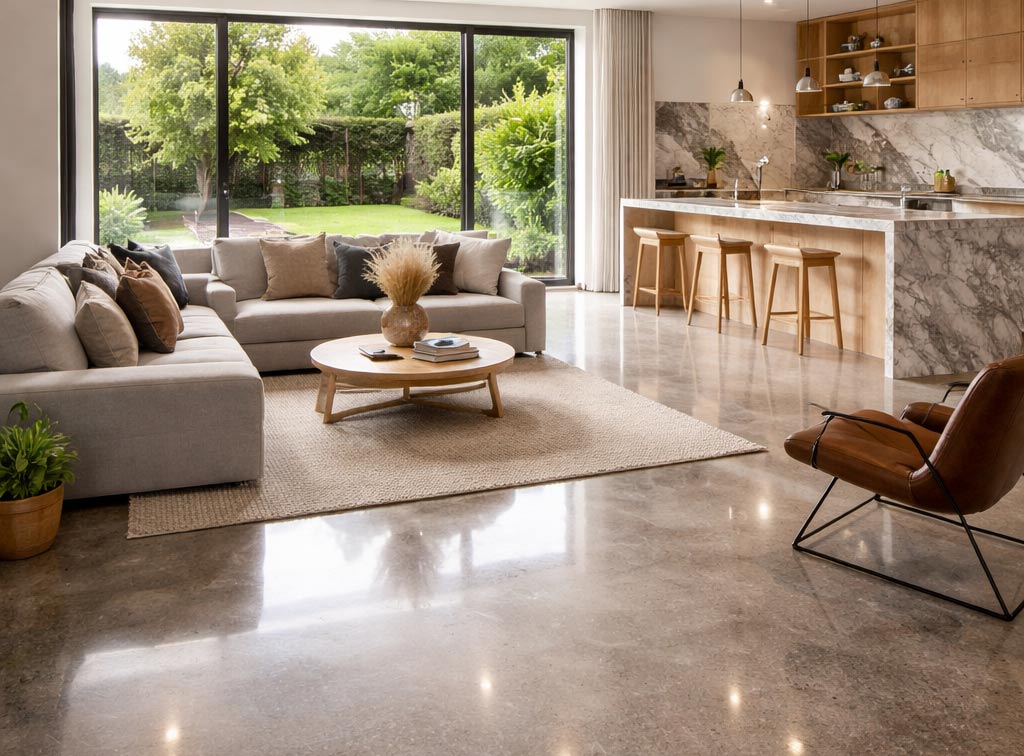
Polished concrete is extremely versatile in different rooms and settings. Its seamless, moisture-resistant surface makes it suitable for kitchens and bathrooms – areas where it is easy to keep clean and won’t swell or warp when wet. In kitchens it provides a modern, industrial-chic backdrop for fittings[12]. A gloss finish under cupboards and island units can reflect under-cabinet lighting.
In living areas and dining rooms, polished concrete works as a minimalist canvas. Its thermal mass keeps floors warmer if sunlit or with underfloor heating. You may want area rugs to soften comfort and acoustics, but overall it ties together open-plan spaces. Thanks to indoor-outdoor continuity, you often see homes with polished concrete inside that carry through to a patio or sunroom, creating one level surface for entertaining. In fact, Grand Designs notes polished concrete is ideal where bi-folds or sliding doors blur indoors and out.
Polished concrete is also very popular in commercial and public spaces. Retail stores, showrooms, hotel lobbies, galleries and offices use it for its durability and ease of maintenance. The high gloss reflectivity brightens large areas. In healthcare, schools and airports, the hygienic, continuous surface is highly prized (no grout lines to harbour germs). Even garages, workshops and industrial floors often use the salt-and-pepper or full-grind finishes for a tough, low-dust surface that can withstand machinery and vehicles. Car park mezzanines and factory halls benefit from the non-slip variants (small grit or matte sealers) and minimal upkeep.
Sustainability and Embodied Carbon
Concrete is a high-embodied-carbon material, but polished concrete floors can still contribute to a greener building when used thoughtfully. By polishing an existing slab (rather than installing new flooring over it), waste and additional materials are minimised. Over its lifetime, a long-lasting polished concrete floor avoids the need to tear up and replace softer, less durable floors (saving future carbon and landfill). The high thermal mass of concrete also improves a home’s energy efficiency by stabilising temperature swings, especially when paired with renewable heating (like solar gain or efficient UFH).
The concrete industry itself is pushing to lower embodied carbon (e.g. by using supplementary cementitious materials like GGBS or fly ash, or new cements). UK-ready-mix concrete now often has CarbonFraction targets and environmental product declarations. Choosing a concrete mix with lower cement content (or using recycled aggregate) can cut emissions. In some cases, adding Phase Change Materials (PCMs) to concrete mixes or using insulation beneath the slab can amplify energy benefits.
To put it in perspective, a typical 100mm-thick concrete slab contains roughly 2 tonnes of CO₂ (from cement production) per 10 m². Spreading that over 50 years of use makes it modest per year. By contrast, having to replace a cheaper floor (timber or vinyl) multiple times over the same period can add up. Designers sometimes use polishing to avoid additional coverings, or blend waste aggregates for a “sustainable terrazzo” look.
In short, polished concrete can be considered a sustainable choice when its longevity, low waste and energy benefits are taken into account. It also supports green building standards: floors with no formaldehyde/glue emissions and that enhance daylight align with targets in BREEAM or LEED. The key is to specify responsibly: ensure the concrete mix itself is as low-carbon as feasible, and remember that no floor is maintenance-free forever – even polished concrete will need resealing after many years.
Underfloor Heating Compatibility
Can you use underfloor heating (UFH) with polished concrete? Yes – in fact it’s an excellent match. Concrete conducts heat very well, so a UFH system under a concrete slab efficiently warms the whole floor. Once heated, the slab retains and radiates warmth evenly, unlike wood which might feel cold. Clients often note how “amazing under-foot” a heated polished concrete floor feels.
Installation-wise, the subfloor is prepared with insulation and pipes or mats laid out, then a reinforced concrete screed (usually at least 75–100mm thick) is poured over it. After the cure time (typically 28 days), the heat can be turned on gradually to prevent shock (too rapid heating can cause shrinkage cracking. Thereafter, the polishing proceeds as normal. The eventual polish allows the heat to come right through to the surface, making spaces feel warm even at lower thermostat settings.
One caution: on cold days with no heating, bare concrete can feel chilly to bare feet compared to carpet. Most UK homeowners with polished concrete simply plan to use UFH year-round. If UFH is not possible, adding rugs in living areas or mats in bathrooms helps keep a comfortable feel. But from an energy-efficiency standpoint, polished concrete plus UFH is one of the best combos for a cozy yet low-energy home.
Maintenance and Repair
How do you keep a polished concrete floor looking its best? Generally, maintenance is simple. Daily or weekly dry-dusting (mopping with a dust mop or use of a vacuum) removes grit that could scratch the surface. When needed, damp-mopping with warm water or a pH-neutral floor cleaner will handle most spills and footprints. Avoid bleach, vinegar or harsh chemicals, as they can dull the shine. Always wipe up spills of wine, oil, juice etc promptly; a well-sealed floor is quite stain-resistant, but letting liquids sit can etch or discolor the surface.
Reapply a fresh coat of the recommended sealer every 3–5 years (depending on footfall). In wear areas like hallways or open-plan family rooms, this might be every 2–3 years, while a low-traffic guestroom might need it only every 5–7 years. The process (by a contractor) involves light sanding and recoating. This periodic resealing essentially “refreshes” the gloss and protects the concrete.
Cracks and chips: Properly poured and cured concrete slabs can develop occasional hairline cracks due to shrinkage or settling. These are often very fine and may not be visible after polishing. Larger cracks (e.g. from structural movement or spikes of UFH) should be filled by a specialist. Polishing over repaired areas can blend them into the floor. Generally, cracking does not indicate a floor failure; it’s manageable with infill and spot sanding. (In a guarantee scenario, an installer may come re-polish or re-seal if warranted.) Minor surface chips or wear spots can be ground out and polished again, so long as the aggregate depth remains consistent.
Dusting/Powdering: A floor that “pows” (leaves white dust) means it wasn’t properly densified or sealed, or the sealer has worn thin. That requires professional buffing and re-coating. But a correctly polished floor will not dust under normal cleaning.
Maintenance Tips (Do’s & Don’ts)
- Do use protective mats at entrances (to trap grit) and soft felt pads under heavy furniture.
- Do sweep or vacuum regularly with a soft head. Microfiber dust mops work well.
- Do keep rubber wheels (chairs) clean to avoid marking.
- Do periodically buff with a cleaning machine if large areas – this revives sheen.
- Don’t use abrasive scrubbing pads or steel wool – it scratches the finish.
- Don’t drag heavy objects across the floor. Lift or use sliders.
- Don’t let spilled liquids pool – blot them quickly.
- Don’t wax or add any floor polish intended for wood on it – these will build up unnaturally.
Costs and Budgeting (UK-specific)
How much does polished concrete cost in the UK? In 2026, typical prices for a new poured-and-polished concrete floor range around £120–£180 per square metre. The variation depends on finish and preparation: a basic matte/semi-polished finish is at the lower end (around £120–£140/m²) and a high-gloss or decorative aggregate finish at the higher end (up to £180/m² or more). Installing a cream finish (power-trowelled, no aggregate) often costs more because of the specialist labour and extra controls (perhaps £150–£200/m²).
If you already have a concrete slab (for example in a new build or extension) and simply want it ground and sealed, rates are much lower. Polishing an existing slab might be around £40–£60/m² for a basic polish. The precise cost depends on the slab’s condition. If repairs, levelling or moisture control are needed first, that adds to expense.
Key cost factors include:
– Area size: Many contractors charge a fixed setup fee plus a per-m² rate, so larger areas give economy of scale.
– Location: UK labour rates vary – expect London/South East prices to be 10–20% higher than more remote areas.
– Finish quality: Mirror finishes and decorative patterns (dyes, coloured aggregates) cost extra for the extra grinding and materials.
– Preparation needed: Old floors might need removal of old coatings or levelling, which increases time.
– Concrete Pour: If pouring new, the cost includes the concrete (roughly £100–120/m³ delivered, plus screeding labour).
– Underfloor heating: If adding UFH, that’s a separate cost (typically £50–£100/m² extra for wiring/mat plus screed layer) – but often the concrete pour covers it.
A rough guide: a simple new polished concrete pour+finish in a modest kitchen (20m²) might cost in the region of £3,000. On the other hand, a high-end lounge of 40m² with a glossy, coloured finish might approach £10,000–£12,000 fully installed.
| Item | Typical UK Cost | Notes |
| New polished concrete (full finish) | £120–£180/m² | Includes concrete, grind, seal. Higher for premium finishes. |
| Polishing existing concrete slab | £40–£60/m² | Surface needs to be sound and flat. |
| Power-trowelled (cream) new slab | £130–£200/m² | Specialist, requires early access. |
| Color dyes or metallic pigments | +£20–£50/m² | On top of base polishing cost. |
| Sealant re-coat (residential) | £10–£20/m² | Every few years as maintenance. |
| Underfloor heating (wet system) | £50–£100/m² additional | Depends on system type & area. |
| Underfloor heating (electric mats) | £40–£70/m² additional | Lower output than water UFH. |
These figures are indicative. Actual quotes will vary. When budgeting, always get a detailed quote for your specific needs. Many installers offer free surveys for accurate pricing.
DIY Polished Concrete – Is It Feasible?
Can you polish concrete yourself? In theory, yes – but it’s a demanding DIY job. The process involves heavy grinding equipment and a lot of technique. A confident DIYer can tackle a small floor (e.g. 10–15m²) using rented tools, but should set realistic expectations.
A typical DIY process (as advised by UK flooring experts) is: clean and strip existing coatings; grind with a coarse diamond pad; apply densifier; then progress through finer grits (often 30, 60, 100, 200, up to 3000 grit for gloss); and finally apply a protective sealer. Key equipment needed: a walk-behind concrete grinder/polisher, a dust extractor (concrete dust is harmful), sets of diamond pads, densifier and sealer. Protect yourself with respirators, safety glasses and ear protection – these grinders are loud and throw up silica dust.
Inexperienced DIYers often trip up: uneven grinding can leave waves or swirl marks; over-sanding can make spots look hazy; and applying densifiers or sealers incorrectly can cause blotches. If the slab isn’t perfectly level to start with, even new concrete can be hard to polish evenly. A common outcome of DIY gone wrong is having to bring in pros later to re-grind and fix mistakes, which can cost more than having it done professionally in the first place.
That said, doing the preparatory steps yourself can save money. For example, one could get an installer to finish (densify, fine-polish and seal) after you’ve roughed it out. But very often, homeowners find that the hire of machinery plus consumables quickly adds up. A professional has machines sized to the job and years of experience. On an 80m² floor, for example, a paid quote might be ~£10,000, whereas renting and handling it yourself might save some cash but at the expense of weeks of labour and risk.
Conclusion on DIY: Only consider it if you have strong DIY skills, a small area and the right equipment. Otherwise, plan to hire a specialist. Many UK pros (e.g. DirectStone, Lazenby, Ecoflor) offer free estimates, so compare their quotes against your DIY cost. Remember, mistakes can be costly and hard to undo.
Health and Safety Considerations
Slip Resistance: A common question is “How slippery is polished concrete?” Modern polished concrete is not inherently dangerous when dry. When sealed, the densifier and sealer actually lock the surface, providing a non-slip surface similar to vitrified tile. In wet conditions, however, any smooth floor can become slippery. Mitigation strategies include: choosing a honed (matte) finish in wet rooms, adding non-slip additives to the final coat (fine sand or silica particles in the sealer), and using rugs or mats where liquids might spill[17]. In public buildings like hospitals or schools, polishers routinely incorporate OSHA/ADA compliant anti-slip treatments to meet safety standards. In a UK home, simple measures like a bathroom mat or towel in the shower are usually sufficient. Polished concrete tends to have better natural slip-resistance than highly polished marble or granite.
Indoor Air (VOCs): As noted, the slab itself emits no VOCs. However, the safety of the floor depends on what is applied to it. Many sealants contain solvents that evaporate (though most floor coatings now are water-based, low-VOC types). To keep air quality high, choose water-based or UV-cured sealers certified low-VOC, and ensure proper ventilation during application. If the concrete pour uses adhesives or membranes (e.g. moisture barrier adhesives), those should be low-VOC products as well. The bottom line: a sealed polished concrete floor generally ranks among the healthiest flooring options in terms of indoor air, far surpassing vinyl, laminate, painted wood or carpet. It also does not harbour dust mites or other allergens.
Fire and Chemicals: Polished concrete is non-flammable – it will not ignite or burn. It also doesn’t release toxic fumes in a fire, making it safe under building regulations. In commercial uses, it easily withstands the cleaning agents and disinfectants used in hospitals or labs. Unlike epoxy or polyurethane floors, it won’t yellow or degrade under UV or chemicals (except very strong acids). So in a fire or spill, it’s one of the safest choices.
Work Safety During Installation: Grinding concrete creates silica dust which is a respiratory hazard (silicosis). Any contractor will use a HEPA dust extractor. If you attempt DIY, always use a proper dust-capture machine or do the job outdoors if possible, wearing an N95/FFP2 respirator. Hearing protection is also needed because grinders are loud. These precautions are standard in professional installations and are why DIY kits recommend a full PPE set.
Planning and Installation Process
Installing a polished concrete floor is a multi-step process requiring careful planning. Here is a typical schedule and workflow:
- Subfloor Preparation: Ensure a flat sub-base. Lay moisture barrier (if needed) and any insulation or underfloor heating tubes. Reinforcement mesh or bars go in at this stage.
- Pour Concrete: A mix is poured (often 75–100mm thick). The mix design can include special aggregates or fibres as required. Skilled finishers use power trowels to level the wet concrete (especially for cream finishes).
- Curing: The slab must cure for at least 28 days. Early on, saw-cut control joints (straight lines) are cut to control cracking. No polishing or traffic should occur during this time.
- Grinding and Polishing: Once fully cured and dry, the surface is ground with diamond-impregnated discs. Multiple passes are made, from coarse to fine grit. After initial grinding, a densifier is applied to harden the concrete (silicate solution). Then finer grits follow, each pass increasing smoothness and sheen.
- Sealing: After reaching the desired polish level, a clear sealer is applied (often two coats). The sealer needs a day or two to dry/cure.
- Finishing: The floor is buffed and cleaned to a uniform shine. Any necessary protective mats are removed, and final touch-ups are done (e.g. adding a matte sealer in entrance areas to reduce slip).
Timeline: From start to finish, plan on 4–6 weeks. Most of that is waiting for the concrete to cure. The actual polishing and sealing work on-site often takes 2–5 days for an average home (less than 50m²). Cream finishes require the polisher on site from pour time, whereas grinding-after approach means contractors arrive after curing.
Getting It Right: Experts advise involving the polished-concrete supplier early, ideally even during planning or before the slab pour. This ensures the concrete mix and placement are suitable for polishing. You might have them specify the mix design or do the pour themselves. Miscommunication can lead to poor troweling or incorrect mix, resulting in a subpar floor that later needs rework.
Leading UK Service Providers and Manufacturers
In the UK, a number of specialist companies install and supply polished concrete. Here are some key names (by no means exhaustive) along with their regions and specialisms:
| Provider | Services | Regions Served | Specialisms | Approx. Price Band (m²) |
| DirectStone Ltd | Polished concrete & stone floor restoration; overlays; decorative concrete | Bedfordshire; UK-wide | Residential & light commercial; stone restoration | £120–200 |
| Lazenby | Designer polished concrete flooring | London, Home Counties | Premium residential; 15 colours; internal & external | £150–250+ |
| Ecoflor | Polished concrete and resin flooring | Bedfordshire, Oxfordshire, Buckinghamshire | Polished overlays; dust-free grinding | £120–180 |
| Concrete Polishing UK | Concrete grinding & polishing; repair | Manchester, North West | Industrial & residential; stained concrete | £100–180 |
| Polished Concrete Plus | Polishing floors & repairs | Leicester area (national) | Commercial & domestic; densifiers | £110–170 |
| British Concrete Polishing | Polished floor installations | Yorkshire & North England | Decorative finishes; colour effects | £120–180 |
| Floors by Salmond | Concrete floor renovation | Scotland | Industrial wear; coating removal | £100–160 |
| LafargeHolcim (Concrete) | Ready-mix concrete; spec guidance | Nationwide | Cement supplier; low-carbon concrete | – (materials only) |
| MAPEI UK | Flooring products (densifiers, toppings) | Nationwide | Chemical products (densifiers, sealers) | – (materials) |
| BECOSAN (EU) | Industrial floor polishing & coating | Europe (incl. UK projects) | Large-scale industrial treatment | Project quotes only |
Most providers price per project. As a rule of thumb, residential installers quote in the £120–£180/m² range for polished finishes. Industrial specialists (like BECOSAN or Floors by Salmond) might charge less per m² on huge areas but often add restoration/repair fees.
Case Studies and Examples
- Modern Apartment, London: An 80m² open-plan loft in London was finished with medium-gloss polished concrete, poured in situ at 100mm depth. Underfloor heating was integrated. The result is a bright, seamless floor that complements the exposed brick wall. Clients noted much brighter lighting and very low cleaning effort.
- Kitchen Extension, Oxfordshire: A family replaced tile with a high-gloss polish over a newly poured slab. They tinted the concrete a pale taupe using integral pigment. The floor absorbs sunlight from rooflights and was warm underfoot on the first chilly autumn morning when paired with UFH.
- Restaurant, Cardiff: A modern restaurant uses a full grind polished concrete floor. Designer stones in the mix give a terrazzo effect that catches the eye of diners. The owners report the floor lasts with only weekly dust and no stains, despite heavy footfall.
- University Building, Exeter: At Exeter Uni, a DirectStone polished concrete floor in a lecture theatre provides an ultra-durable surface. It was finished with a dense sealer and the low-reflective satin polish minimizes glare from stage lights. Staff appreciate how easy it is to keep clean, even when spilled coffee runs across it.
- Grand Designs Renovation: A Victorian house was featured in a UK home magazine with a cream polished concrete floor laid over a new slab. The architect had the concrete truck pour into place and immediately invited the polisher to smooth it. The final matte floor mirrors the rustic brickwork and needs just routine sweeping to maintain.
These examples illustrate typical benefits: long lifespan, design impact and ease of maintenance in diverse UK settings.
Common Problems and Troubleshooting
Even the best concrete can have issues if something goes wrong. Here are some common concerns:
- Cracking: As mentioned, concrete can crack due to curing stress or building movement. Usually these cracks are hairline and stable. To avoid visible cracks, install control joints and make sure the slab cures gently. If cracks do appear post-install, they can be filled with matching resin or grout and repolished. Many contractors honour warranties covering structural cracks if they arise.
- Uneven Shine: If parts of the floor look duller, it may be due to inconsistent polishing or subfloor moisture. This often means the sealer layer is uneven. A handyman solution is to use a polishing compound and buff the dull area. For persistent issues, a contractor can screen and recoat the floor in those zones.
- Stains or Discoloration: These usually come from acidic spills (e.g. vinegar, wine) or metal rust (from furniture legs). The fix is spot-cleaning with a neutralising agent followed by resealing. For serious stains, repolish past the affected layer then seal. Prevent by using a stain-resistant sealer and mats in risky spots.
- Peeling Sealer: This happens if the old sealant wore out or was not properly applied. The solution is to strip or grind off the old sealer and reapply new sealer. It’s not difficult for a pro, but neglect can let the concrete become powdery (requiring densification again).
- Slippery when Wet: If slipperiness is a concern (e.g. shower room), one can broadcast a fine grit into the final wet sealer, or use a honed/matte finish instead of glossy. Anti-slip mats or coatings are a quick retrofit solution.
In general, most problems are fixable with some professional attention. Polished concrete has few moving parts, so major issues are rare if the floor was installed correctly.
Frequently Asked Questions
Q: How slippery is polished concrete when wet? Answer: Polished concrete has decent grip when dry, but it can become slippery if wet. The dense surface provides some natural friction, but liquids reduce traction just as they would on tiles. To mitigate this, consider a non-slip finish in bathrooms (e.g. a honed sealer with fine grit), or place mats and rugs in potentially wet zones[17]. In the home, most people find that normal careful behaviour (drying up spills quickly, wearing slippers) is enough. Commercial clients often use anti-slip additives.
Q: Does polished concrete feel cold underfoot? Answer: It can feel cooler in winter if unheated, because concrete naturally conducts heat away. However, its high thermal mass means it retains any warmth well. Most UK installations pair polished concrete with underfloor heating, which turns it into a comfortably warm surface. In rooms without UFH, people commonly use rugs or slippers to offset the coolness.
Q: Can I add colour or patterns to polished concrete? Answer: Yes. You can use integral pigments in the mix or surface dyes during polishing to tint the concrete any colour. There are even metallic dyes for shimmer. One can also embed decorative elements (like metal strips or logos) before grinding. However, colours must be planned carefully – for example, white or light colours require a white cement mix and very careful sealing to avoid yellowing. Always test a patch first.
Q: Can I polish existing concrete or a subfloor screed? Answer: In most cases, yes. If the slab is level, dry and crack-free, it can be ground and polished just like a new floor. The result will reflect the material’s characteristics. For very old or weak screeds, one might first apply a bonding or reinforcing layer. Good installers will assess the slab and quote for any prep needed before polishing.
Q: What floor coverings look similar if I can’t do polished concrete? Answer: If the budget or schedule won’t allow polished concrete, alternatives include large-format porcelain or vitrified tiles (easy to clean, good water resistance), microcement overlay (a cement-based skim coat that can mimic polish in colour and texture), and luxury vinyl planks/tiles (LVT) for a warmer, cushioned feel. These can imitate stone or concrete looks. However, note that none of these have the same thermal mass, and each has its own maintenance needs (grout lines on tile, risk of cutting/delamination on vinyl).
Q: How long will a polished concrete floor last? Answer: A well-installed polished concrete floor can last 30–50 years or more under normal domestic use. It is common for industrial polished floors (in factories or showrooms) to run for decades without replacement. The limitation is usually the life of the top sealer, which can be renewed periodically. Structurally, the concrete will outlast most of the building around it.
Q: Do I need planning permission or building regs? Answer: Polished concrete itself is just a finish, so no special permission is needed beyond normal building consent for the subfloor or extension work. If you pour a new concrete floor slab, then Part L (thermal performance) may apply (use insulation under the slab if required) and Part C (moisture) as well. The installer should provide compliance evidence for any UFH or damp-proofing. Generally, however, replacing an existing floor covering with polished concrete is a “permitted development” refurbishment.
References
- Checkatrade (2026) – “Polished concrete floor cost & prices in 2026” (UK guide to prices and benefits).
- Homebuilding & Renovating (2019–2025) – “Polished Concrete Guide” (explains process, benefits, costs in UK context).
- Carr Concrete Polisher (CARRcrete) – “Polished Concrete: The Definitive Guide” (UK flooring specialist, covers benefits, finishes, densification).
- Ecoflor (2023) – “Polished Concrete: Your Choice for an Eco-Friendly Space” (industry blog on indoor air quality and sustainability of polished concrete).
- Xtreme Polishing Systems (2019) – “How Safe is Polished Concrete Flooring?” (US sources on safety, slip resistance, hygiene, durability).
- Self-build Magazine (2023) – “Polished Concrete Floors: Complete Guide to Costs, Design & Installation” (UK self-build resource on costs, maintenance, FAQs).
- Heidelberg Materials UK (by Hanson Aggregates) – “Polished concrete floors” (technical info on process, advantages, cost in UK).
- DirectStone Ltd (2025) – “Can You DIY Polished Concrete Flooring?” (UK contractor blog, steps and warnings for DIY polishing).
- British Concrete Polishing (2023) – “What Colour Options Are Available for Polished Concrete Floors?” (UK company blog on colouring methods and popular shades).
- Polish the Planet (2024) – “Polished concrete and noise reduction” (blog discussing acoustics and other practical benefits of polished concrete).
- Grand Designs Magazine (2022) – “Polished concrete flooring guide: Price, pros and cons” (UK home design article covering finishes like cream, densifiers and installers’ advice).
Polished Concrete Guide | Homebuilding
https://www.homebuilding.co.uk/ideas/polished-concrete-guide
Polished Concrete The Definitive Guide by CARRcrete
https://concretefloorpolisher.co.uk/polished-concrete-guide/
Polished concrete flooring guide – price, pros and cons and more – Grand Designs Magazine : Grand Designs Magazine
Polished Concrete Eco Friendly: A Sustainable Choice | Ecoflor
https://www.ecoflor.co.uk/polished-concrete-your-choice-for-an-eco-friendly-space/
Blog – Polished concrete and noise reduction
https://www.polishtheplanet.com/blog/article/polished-concrete-and-noise-reduction
How Safe is Polished Concrete Flooring
Polished Concrete Floors FAQs & Cost | Heidelberg Materials UK
Polished Concrete Floors – Your Complete Guide to Costs, Design & Installation
https://www.self-build.co.uk/polished-concrete-flooring-explained/
What Colour Options Are Available for Polished Concrete Floors?
https://www.britishconcretepolishing.co.uk/blog/polished-concrete-colours/
Can You DIY Polished Concrete Flooring? Click Here to Find Out
https://www.directstone.co.uk/can-you-diy-polished-concrete-flooring/