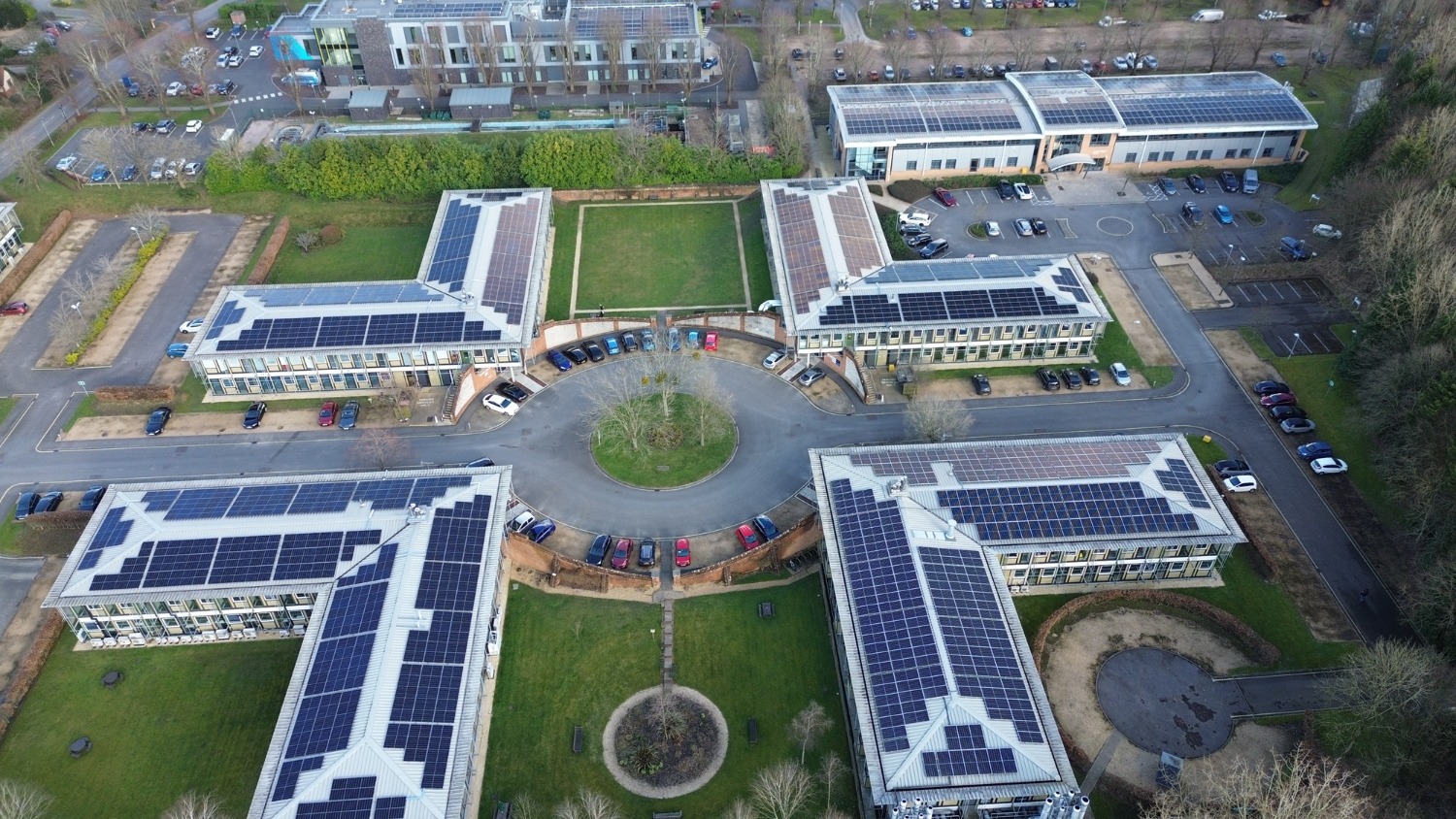
Absolar has announced that Southampton Science Park has become the first science park in the UK to reach 1 megawatt (MW) of installed solar capacity which is a landmark milestone that will prevent 220 Tonnes of CO₂ emissions annually.
January 2026 was one of the wettest on record for southern England. Despite 39% higher rainfall compared to January 2025, Absolar’s monitoring data shows that generation in January 2026 reached 95% of the previous year’s output, indicating limited performance sensitivity to prolonged rainfall.
Based on estimated annual generation, the 1MW installation produces enough clean electricity each year to power approximately 260 average UK homes and avoid around 220 tonnes of CO₂ emissions, comparable to removing roughly 50 cars from the road annually. The milestone positions Southampton Science Park as a national leader in estate-scale renewable energy implementation.
Resilience tested, with record rainfall leading to minimal impact
The timing of the milestone has provided an unexpected opportunity to demonstrate solar performance under extreme conditions. Meteorological data confirms that January 2026 brought record breaking rainfall to southern England, with some areas experiencing precipitation every single day of the month.
Absolar’s performance monitoring at Southampton Science Park revealed:
- January 2025: 13,855.2 kWh generated, with 129mm rainfall
- January 2026: 13,167.4 kWh generated, with 179mm rainfall
- Result: Only 5% reduction in output despite 39% more rainfall
“Solar panels generate electricity from daylight, not just direct sunlight,” explained Dr Phil Wu, Absolar CEO. “Overcast conditions reduce peak generation but don’t switch systems off. Well designed systems are modelled for UK weather realities where there are poor weeks and average months, not only ideal conditions.”
The persistent rain also provided an additional benefit which is natural cleaning of the panels, washing away dust, pollen and debris that can accumulate during dry periods and helping maintain efficiency without manual cleaning.
How a university spin out is now powering its own business home
In a testament to the Science Park’s role in nurturing innovation, Absolar was founded by University of Southampton alumni and is headquartered at the park. Achieving the milestone brings the company’s journey full circle by delivering 1MW of solar capacity to the very site that launched the business.
“This represents more than a commercial project,” said Dr Wu. “Our team of engineers and scientists were educated at Southampton, incubated at the Science Park and now we’re powering our own campus with clean energy. It’s proof that the innovation ecosystem here works.”
Absolar is unlike traditional solar installers. The company uses proprietary AI-powered remote sensing and LiDAR technology to survey multiple buildings simultaneously with complete accuracy.
It’s unique offering is unlocking rooftop solar potential across the UK where less than 5% of buildings currently have solar installations [Ordnance Survey 2025: https://www.ordnancesurvey.co.uk/news/new-roof-data-for-over-40-million-buildings]. The technology has attracted partnerships with a huge number of organisations including The Royal Air Force, NatWest and multiple councils.
A blueprint for the future?
The achievement demonstrates the solar potential across the UK’s 100+ science parks and innovation districts. Southampton’s milestone could provide a blue print for other large scale installations, especially as Absolar’s technology provides reliable remote assessment, which makes solar more accessible for organisations that may not have known where to start.
Absolar’s expertise allows whole cities, estates or single buildings to be analysed remotely in incredible detail, identifying the very best rooftops for solar power without needing a single physical survey.
The installation at Southampton Science Park currently comprises solar systems across 10 buildings, with panels integrated into the campus infrastructure to provide renewable energy directly to resident companies while reducing operating costs for the estate.
Stuart Perry, Operations Director at Southampton Science Park commented:
“Reaching 1 megawatt of solar capacity makes Southampton Science Park a national leader in estate sustainability. We’re proud that this milestone was achieved in partnership with Absolar, a company that exemplifies exactly what we aim to foster here, which is innovative businesses that grow from university research into industry leaders. The installation now provides our tenant companies with access to clean energy, reducing costs while supporting their own net zero commitments.”
With electricity demand projected to double by 2050 as the UK electrifies heating and transport, estate scale solar installations like Southampton Science Park’s 1MW system will be critical infrastructure in achieving net zero targets.