The West Midlands Combined Authority (WMCA) has initiated its largest fundraising campaign to date, aiming to secure £150 million from both private and public sectors to support a wide range of nature projects across the region.
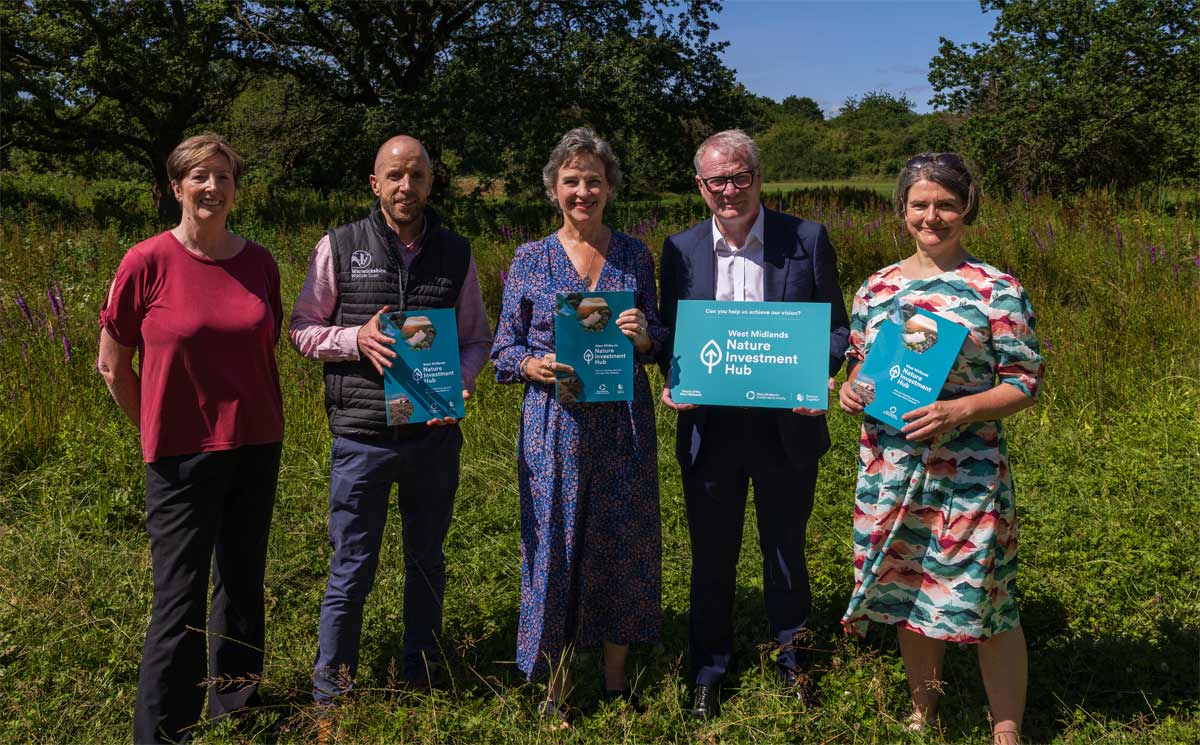
This ambitious funding drive is designed to implement the Local Nature Recovery Strategy (LNRS), which focuses on protecting and enhancing urban nature sites spanning an area equivalent to 50,000 football pitches. The initiative was officially launched in Coventry by Richard Parker, Mayor of the West Midlands, alongside Mary Creagh, the government’s Minister for Nature.
The newly established Nature Investment Hub, one of the UK’s pioneering regional fundraising platforms, seeks to connect businesses with projects that aim to expand green spaces, improve biodiversity, and enhance air and water quality. It also intends to bolster the region’s resilience to climate change.
Mayor Parker emphasised the economic and social importance of nature, stating: “Nature is one of our greatest assets and is in fact critical infrastructure in its own right. Our economy is already £700m a year better off because of nature and our plan will bring additional value to help it survive and thrive.” He highlighted the health benefits of improved access to nature, which can reduce pressure on the NHS and support employment. “Every new tree we plant shields more homes, businesses, roads and railways from the impact of climate change,” he added.
Mary Creagh praised the Hub’s role in delivering diverse nature recovery projects, from tree planting to river restoration and heathland re-establishment. She described the Hub as “proof of what can be achieved when we join up investors and businesses committed to environmental improvement with local nature projects ready to deliver action on the ground.”
The West Midlands is among five regions collaborating with the Department for Environment, Food & Rural Affairs (Defra) on a place-based delivery pathfinder project. This initiative aims to tailor Defra’s services to meet local needs and priorities, with the Nature Investment Hub central to developing a pipeline of nature recovery projects.
Initial investment opportunities listed on the Hub total £2 million and include expanding Coventry’s Tiny Forests network, establishing a community tree nursery in Birmingham, restoring a river stretch in Solihull, and re-establishing historic heathland in the Black Country.
To mark the launch, Parker, Creagh, and Coventry City Council deputy leader Lynnette Kelly visited Lake View Park, a 30-acre site near Coventry city centre where Warwickshire Wildlife Trust has restored the River Sherbourne. The river’s natural flow was reinstated after being straightened, and new wetlands and ponds have been created, providing habitats for diverse species and reducing flood risks. This project was supported by a National Lottery Heritage Fund grant.
Warwickshire Wildlife Trust plans to extend this success through its Ripple Effect Pond Project, aiming to create or restore 100 wildlife-rich ponds across the Meriden Gap, Solihull, Coventry, and Warwickshire, pending funding secured via the Hub.
Ian Jelley, director of landscape recovery at Warwickshire Wildlife Trust, described the Hub as “a brilliant opportunity for local businesses to support high-impact nature initiatives on their doorstep.” He noted the collaborative approach between public, private, and environmental partners as a model for scaling nature recovery beyond the region.
Cllr Lynnette Kelly highlighted the benefits for businesses and communities, stating: “This is a brilliant opportunity for businesses who want to connect with nature and do something that will improve the environment for residents and of course for wildlife.” She emphasised the economic and social advantages of green initiatives and encouraged local businesses to participate.
Defra is evaluating insights from the West Midlands and other pathfinder projects to inform its service delivery nationwide. Businesses interested in supporting local nature projects or organisations seeking funding can find further information on the Nature Investment Hub website.
The WMCA region contains 7,000 hectares of accessible green space, accounting for 8% of land cover. However, fewer than one-third of the three million residents can access these sites within 15 minutes, a benchmark known as the ‘doorstep’ standard. The LNRS, published last year, includes 62 actions to create new nature sites and enhance existing green spaces, waterways, and wildlife habitats.
The LNRS estimates the annual economic and social value of nature in the West Midlands at £676 million, reflecting benefits such as improved physical and mental health, climate regulation, pollution reduction, and increased property values. Nature-based solutions can address approximately one-third of the region’s climate adaptation needs.
The area’s five million trees absorb 1.5 million cubic metres of rainwater annually, equivalent to filling the pools at Sandwell Aquatics Centre 300 times. Street trees can lower ambient air temperatures by up to 3 degrees Celsius and remove over 200,000 tonnes of airborne pollutants each year, while storing 57,000 tonnes of carbon.
Mayor Parker has already allocated more than £1.6 million of WMCA funding to 100 community-led environmental projects aimed at protecting nature and improving air quality. The LNRS was developed collaboratively by WMCA, local councils, environmental organisations, community groups, businesses, educational institutions, landowners, farmers, and developers to ensure broad participation in nature conservation efforts.